Ski Touring in Rugova: The Cradle of Balkan Skiing
Kosovo’s largest Accursed Mountains valley, twenty minutes from a city
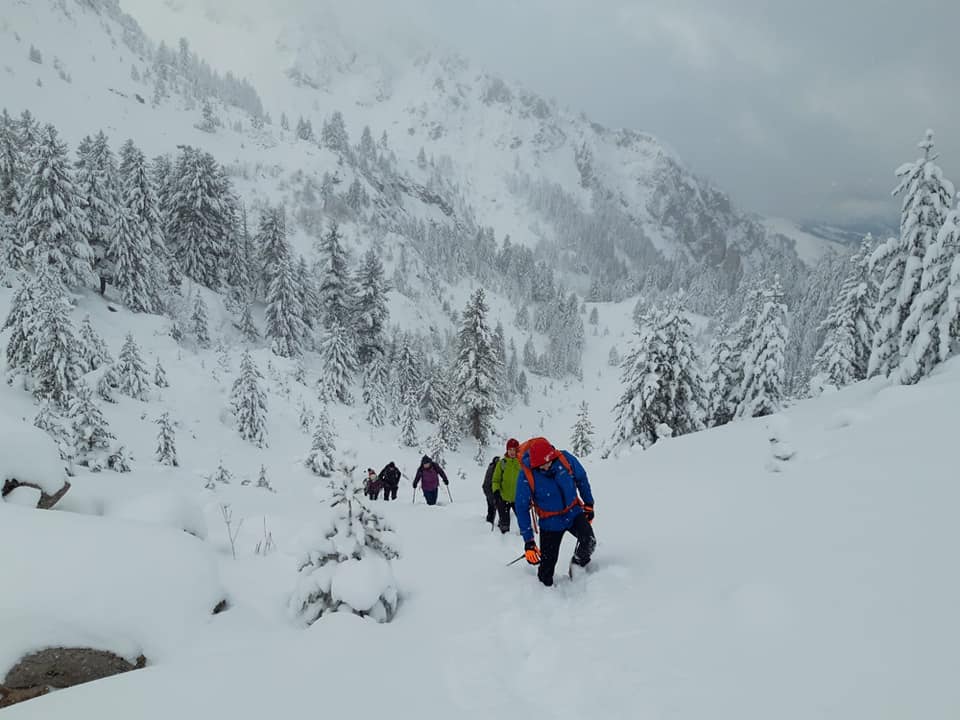
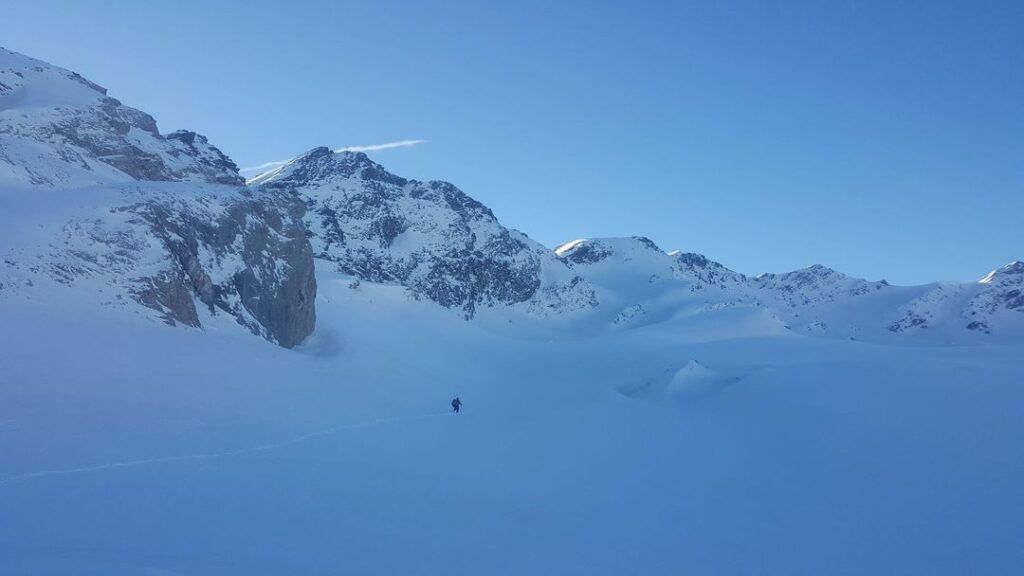
The Rugova valley runs west from Peja into the heart of the Accursed Mountains — the largest valley in the range on the Kosovar side, and the most accessible serious ski touring terrain in the country. From the centre of Peja to the trailheads is a drive of twenty to forty minutes. Few places anywhere in Europe put 2,400-metre border summits and untracked snow that close to a city with hotels, restaurants and an airport two hours away.
Rugova is known as the cradle of skiing in Kosovo and, by local reckoning, in the Balkans. The reason is straightforward: for a long period skiing here was the preserve of alpinists rather than a separate sport. Rugova’s gorges, caves and high peaks drew mountaineers of every nationality for generations, and in winter they simply strapped planks to their mountain boots and carried on doing what they had always done. When skiing broadened into a recreation, Rugova was the logical place for it to take root. The Rusolia club was founded here and competed at the Olympic Games; Peja, Alpi and Rugova clubs followed.
That history matters for the touring today. This is a valley with a mountaineering culture, an established mountain rescue group, guesthouses accustomed to winter guests, and a network of local guides — a very different proposition from the improvised logistics of Doberdol or Babino Polje.
Why Ski Tour Rugova
- Access without compromise. Peja is a real town with real accommodation, and the terrain starts half an hour away. No multi-day approach, no committing to a remote guesthouse before you know the conditions.
- A genuine range of terrain in one valley. Sunny rolling runs below 30° in the Bogë valley; a rocky border crest at Hajla with a sheer Montenegrin drop; the highest peak in Kosovo at the valley’s southern end. Days can be chosen to match conditions rather than the other way round.
- Cat skiing. Bogë is the best place in Kosovo for cat-assisted access — gentle terrain with a handful of steeper, higher descents for stronger skiers.
- Cross-border touring on your doorstep. The Shkodra Pass and Hajla both sit on the Montenegrin border. With a valid passport and the right permits, skiing across is a practical option rather than a stunt.
- Local infrastructure that actually exists. Guesthouses, guides, ski schools at Bogë, and an organised mountaineering rescue group of 30–40 people — the closest thing to a safety net anywhere in the Kosovar mountains.
The Terrain
Rugova divides into two distinct characters, and choosing between them is most of the planning.
Bogë and the developed end. The village of Bogë sits at roughly 1,400 m on the southern slopes below Hajla, about 21–30 km west of Peja. It is a popular local spot — barbecues, weekend outings, holiday cottages — with a small ski area of around 3 km of pistes served by a single lift, running roughly 1,360 m to 1,570 m. Two ski schools operate here. For a tourer, the value is the cat skiing and the easy valley terrain: sunny, rolling runs, nothing steeper than 30°, skiing among low coniferous and deciduous trees. There is a touring trail through the village of Shkrel, but the area can be busy and noisy, and it is not where the good lines are.
The wild end. Everything else. Mount Hajla, the Shkodra Pass, the upper valleys toward Kuqishtë and Drelaj, and the long southern approaches to Gjeravica. Here you will most likely see nobody at all.
Key Summits
Gjeravica — 2,656 m. The highest peak in Kosovo, the second-highest in the Accursed Mountains, and the sixth-highest in the Balkans. It stands nearly alone, visible from much of the country, surrounded by glacial lakes and the source of the Erenik river. The summit view takes in the Albanian Alps, the Prokletije and nearly all of Kosovo’s mountains. In winter it is a serious objective: above roughly 2,400 m the snow frequently turns to ice, and crampons and ice axe are commonly required for the final section. See our full Gjeravica guide.
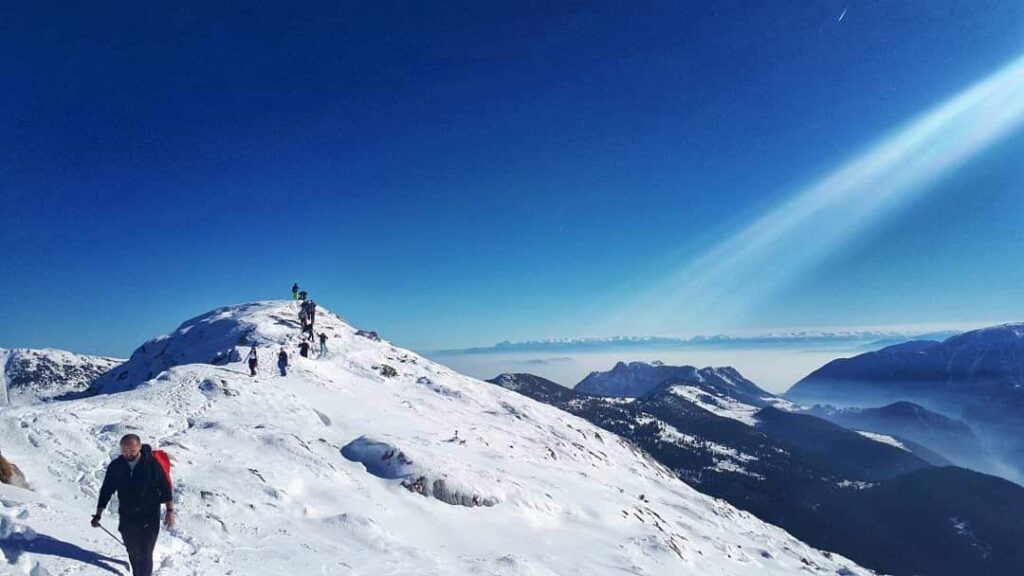
Hajla — 2,403 m. The border summit between Peja and Rozajë in Montenegro, and the signature Rugova tour. A rocky crest that falls sheer on the Montenegrin side and rolls in gentle meadow on the Kosovar side — a mountain with two completely different faces. The summit view spans the entire northern boundary of the Accursed Mountains, from the cliffs dropping into northern Montenegro across the forested Kosovar foothills below the walls of Guri i Kuq, out to Gjeravica, the Komovi and the Albanian Alps.
Shkodra Pass — 2,300 m. On the Kosovo–Montenegro border above the village of Kuqishtë. Not a summit but a crossing — the natural link between Rugova and Babino Polje in Montenegro, and the key to any traverse heading north.
Guri i Kuq. The formidable wall dominating the Kosovar foothills below Hajla. A landmark on every Rugova skyline.
Classic Routes
Hajla from Reka e Allagës — 2,403 m
The classic. The peak is climbed from two Rugova villages, Reka e Allagës and Pepaj, with Pepaj carrying slightly less elevation gain. The southern slope is the standard winter line. In summer the walk from Reka e Allagës takes around three hours; on skins in winter, allow considerably more. The descent returns to Reka e Allagës village.
Kuqishtë to Shkodra Pass and Babino Polje
A transfer to the village of Kuqishtë, then the climb to the Shkodra Pass at 2,300 m on the Kosovo–Montenegro border. From the pass, descend north into Babino Polje. Roughly a full day, and the standard first stage of a Rugova-to-Montenegro traverse.
Gjeravica — 2,656 m
Rarely skied as a day trip from Rugova. The usual winter approaches come from the west and south — Doberdol via the Ali Peja Pass, Rupa Dobroš from the Deçan valley, Bogićevica in Montenegro — or from the east via Gropa e Erenikut, accessed by 4×4 from Junik, which is the shortest ascent. The western routes intersect at Liqeni i Tropojës and the Ali Peja Pass on the Albania–Kosovo border. Expect ice above 2,400 m and carry crampons and an axe.
Bogë Valley Cat Skiing
Cat-assisted access to gentle rolling terrain with tree skiing among low conifers and deciduous stands, plus a handful of higher, more demanding descents. The valley sits on the Montenegrin border, so with a valid passport a cross-border run is possible.
Where to Stay
Rugova has the best accommodation situation of any destination in this guide.
Peja is the practical base for most of the valley — a proper town with hotels, hostels and restaurants, twenty to forty minutes from the trailheads. Hostel Bora is a long-standing favourite among visiting ski groups.
Bogë has a substantial stock of holiday cottages and guesthouses, built up around the ski area, and is the obvious base for cat skiing days.
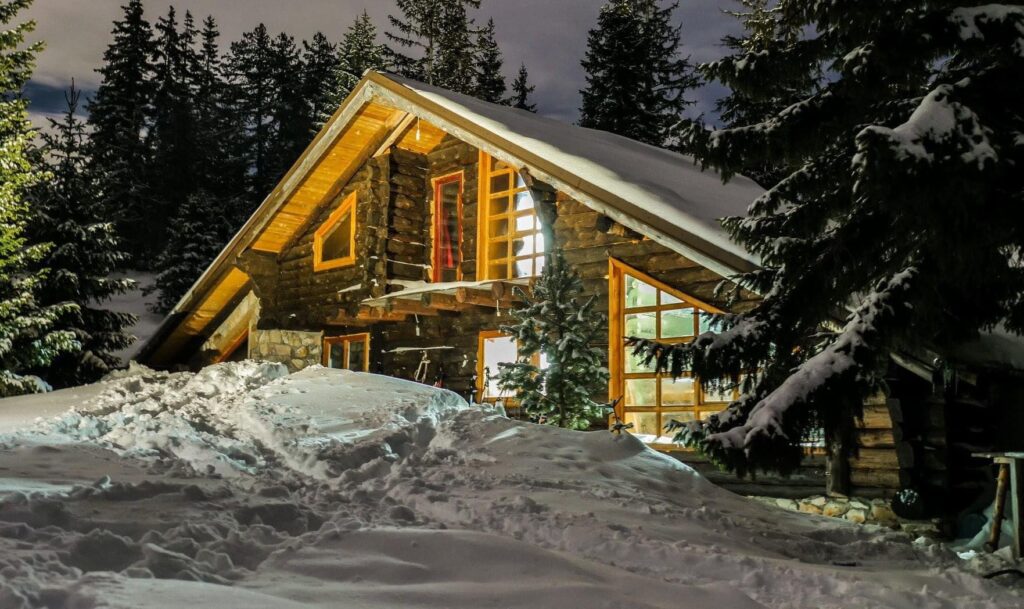
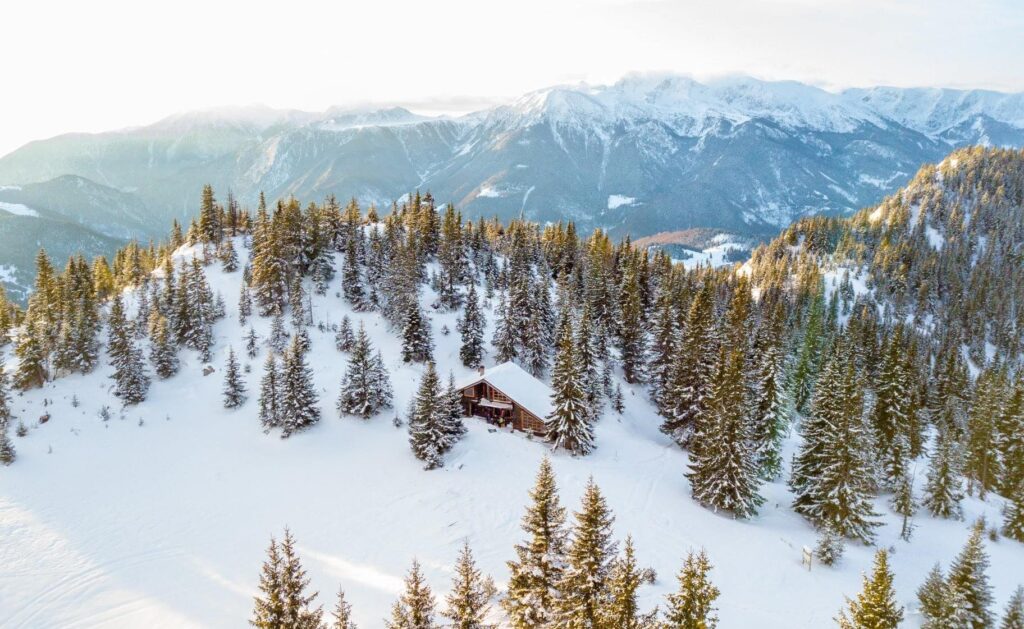
Village guesthouses through the valley take winter guests — Guesthouse Ari in the Reka e Allagës area is among the best known, and a standard overnight on Peaks of the Balkans ski traverses. There is also a cabin at Hajla used by touring groups.
Unlike Doberdol or Gaçaferi, none of this needs to be booked a season ahead. It is the one place in the Kosovar mountains where you can arrive with a rough plan and sort the details locally.
Practical Information
| Location | Rugova valley, west of Peja, Accursed Mountains, Kosovo |
| Valley bases | Peja (city), Bogë, Kuqishtë, Reka e Allagës, Pepaj, Drelaj |
| Elevation range | c. 1,360 m – 2,656 m |
| Best season | January to March |
| Difficulty | Easy to advanced depending on objective. Bogë valley is gentle; Gjeravica is serious |
| Requirements | Off-piste competence for valley terrain; crampons and axe for Gjeravica |
| Access | 20–40 minutes from Peja; c. 1.5–2 hours from Prishtina (PRN) |
| Bogë ski area | c. 3 km of pistes, one lift, 1,360–1,570 m; two ski schools |
| Borders | Hajla, Shkodra Pass and the Bogë valley all sit on the Montenegrin border — permits required for crossings |
| Rescue | Local mountaineering rescue group of 30–40 people — the only organised capacity of its kind in the Kosovar mountains |
Safety and Avalanche Awareness
Rugova is the best-supported ski touring area in Kosovo, and that is a relative statement rather than a reassuring one. There is still no avalanche control, no public avalanche forecast covering the Accursed Mountains, and no reliable snow reporting. The mountaineering rescue group is a genuine asset — it exists, it is organised, and it responds to incidents — but it is a volunteer capacity, not an alpine rescue service with helicopters on standby.
Hajla’s two faces make it a mountain to treat with respect. The gentle Kosovar meadow side is straightforward; the Montenegrin side is a sheer drop, and the crest between them is rocky and exposed. Navigation error near the summit in poor visibility has obvious consequences.
Gjeravica in winter is a different order of undertaking from the valley touring. Ice above 2,400 m is routine, crampons and an axe are frequently necessary, and the approaches are long. It should not be attempted as a casual extension of a Rugova week.
Full avalanche equipment — transceiver, probe, shovel — and the training to use it are mandatory. Bears, wolves and lynx are present in the Bjeshkët e Nemuna National Park.
Plan Your Trip
See our guides to the Accursed Mountains and Gjeravica, or book a guided ski touring trip in Kosovo via Balkan Natural Adventure.